
A History of The River Rother: Lifeblood of West Sussex

The following is a summary of the talk given by Dave Rudwick of the Midhurst Society on 26th June 2025.
A lot of the history of the River Rother can still be seen in its mills, bridges and the various weirs, sluices and other impoundments that humanity has imposed upon the river.
Water mills have existed along the River Rother since at least 1086 which we know as some are recorded in the Doomsday book, such as a mill at Woolbeding; with transport being the river’s second main historical use. The river was used in Cocking for watercress beds on Costers Brook, a tributary of the Rother in the early 20th century.
Boats used the section from the Arun to Fittleworth following changes made to the Arun in 1615, and after the Arun Navigation was completed in 1790, the 3rd Earl of Egremont made the river navigable up to Midhurst by constructing eight locks creating a rise of some 54 feet (16m), aas well as constructing some small cuts. The work was completed in 1794, and many of the bridges built at that time still survive. River traffic consisted of coal transported up-river, with cargoes of timber, corn and Petworth marble going in the other direction.
With the opening of the Mid-Sussex Railway branch to Midhurst in 1859, river traffic declined, and commercial use of the river had ceased by the 1880s. Pleasure boats continued to be used on the river for many years and published accounts of journeys along the decaying navigation appeared in 1914 and 1920. The navigation was officially abandoned in 1936, after an undergraduate pointed out that it was still a public right of way.
We often think of mills being used for grinding grains into flour but at Iping there was a paper mill, with the paper being made from rags which were pounded to break up the fibres. Mills were prone to flooding but more significantly to fire as the dust in the air could be flammable. Iping Paper Mill burnt down in 1925.
Before steam power, flowing water was the power source for processing iron ore. Water mills drove bellows to fire high temperatures in iron furnaces, and to power the hammers. Cast iron was taken by ox carts to the hammer mill on the Rother near Haben bridge, Rogate, where it was melted again and the impurities beaten out of it, creating wrought iron.
Chorley Iron Foundry, just north of Cocking, on Costers Brook, was where they cast several of the local mill wheels. The different elements of the Coultershaw Beam Pump were also cast at Cocking in the mid 19th Century with the beam pump then used to pump water to Petworth, including to Petworth House.
The use of water power on the Rother to grind flour persists to this day with Burton Mill still using water powered milling machinery to grind locally grown wheat into flour.
The legacy of the historical use of the Rother for both industry and transport can be seen in the bridges and mills that still survive and are in use. Dave took us on a pictorial journey down the Rother from its source near Empshott to where it flows into the Arun, showing us ‘then and now’ images of bridges and a surprising number of mills, many of them now being private dwellings.
We learnt that Haben Bridge is thought to have been built by the monks from Durford Abbey, who also built the bridges at Trotton and Maidenmarsh. Our speaker then asked us if anyone knew where Maidenmarsh was and, fortuitously, we had an ERA member from Maidenmarsh in the audience!
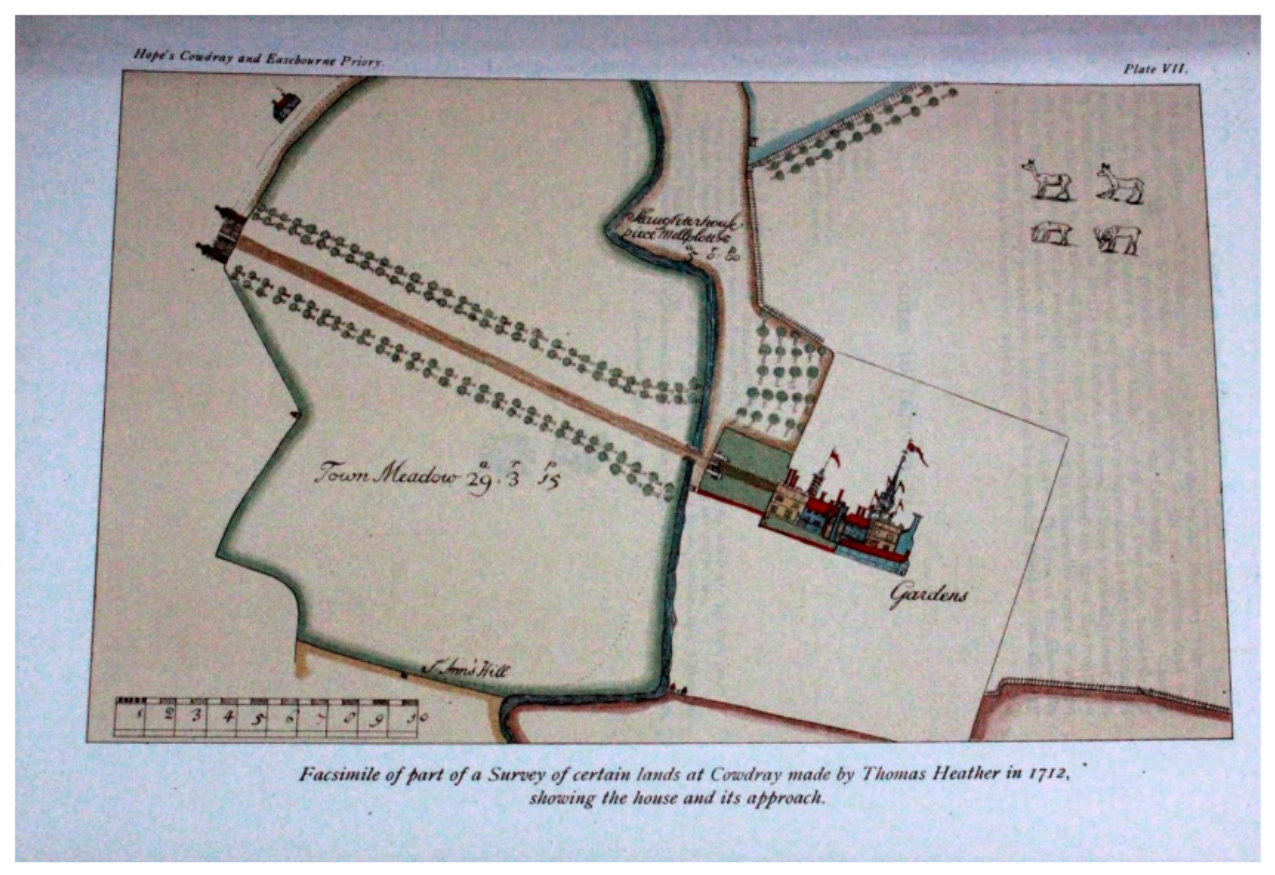
This image of Cowdray, Midhurst, which Dave showed us would seem to show that the course of the Rother (shown flowing from top middle to bottom middle) has been changed such that it now flows picturesquely in front of the Tudor palace – which would certainly make sense of the bridge half way down the causeway.
Although commercial use of the river for industry or transport ceased in the 1880s, Dave wanted to leave us with an appreciation of the many different ways the river is still of value to us all now. He spoke of its value to wildlife, supporting brown trout, lampreys, eels, otters, kingfishers, wagtails, crayfish etc., and its value to us for recreation, exercise, fishing, as well having cultural value being a source of inspiration to writers and artists. Dave didn’t get any argument from us as to the value of our river!