
Peter, Senior Lecturer in Water and Environmental Engineering at Portsmouth University, gave us so much to think about regarding wastewater and its treatment, from the question of how we arrived at where we are, to what the current issues are, and on to the role of citizen science within this general picture.
We have some of the oldest water industry infrastructure, with most of it being a combined system (wastewater plus rainwater), we have low levels of investment into the system, rigid and in some cases outdated regulations, and underfunded regulatory bodies. All of this has led to there being a gap in monitoring that is thankfully being, at least in part, filled by voluntary citizen science groups. This includes ERA’s own E.coli project. Peter went on to review the validity of our work, to consider where our link with his department might take us next, and to give us some ideas as to what we can all do, individually and collectively to improve the health of our waterways.
What is the current situation wrt sewage pollution?
Peter began by explaining why the issues surrounding sewage are so much in the news currently:
· We have aging infrastructure
· There are more of us and with modern washing machines, dish washers, power showers etc we are using more water per person
· Our rapidly changing climate, with dry summers and warmer, wetter winters, is adding strain to the system
· We are making increasing recreational use of our waterways and seas
· We all hear about it more, be that on social media or more traditional news media
In August 2019, Emma Howard Boyd, Chair of the Environment Agency, claimed in a letter in The Times that, ‘Water Quality in our rivers is now better than at any time since the start of the industrial revolution’. Peter has given that statement consideration, concluding that the reality is rather more complex than that. For a start, we now export our pollution by most of our manufacturing happening elsewhere – we off-shore both our pollution and the carbon footprint of creating so much of what we have.
At the start of the industrial revolution, we didn’t bother treating anything, so improvements have been made, particularly since 1990. On the other side of the scale, our changes in lifestyle have meant that there are additional ‘emerging’ pollutants, such as pharmaceuticals, pesticides, personal care products, and PFAs, which we are not monitoring or treating. Nutrients, from fertilisers and sewage, are going to be a huge focus for the next 10 years, estimated at costing some £5.3bn for England & Wales alone.
How did we arrive where we are?
We have moved from households having earth closets or cesspools to all having flush toilets, as well as other modern amenities, which has placed a great strain on the water and sanitation system.
Thomas Cubit, in 1840, admirably described the effect of this for the Thames, “Fifty years ago nearly all London had every house cleansed into a large cesspool... Now sewers having been very much improved, scarcely any person thinks of making a cesspool, but it is carried off at once into the river. The Thames in now made a great cesspool instead of each person having one of his own."
It was The Great Stink of 1858, in London that led to Sir Joseph William Bazalgette designing a sewage system to take the sewage away from the city itself. Part of the reason why polluting the river was not seen as a problem was that the belief at the time was that people got ill from bad air, and sewage was not considered as being a health risk.
The new piped sewage systems built upon the system for taking rainwater away, so we had a combined system from this beginning, which remains one of the biggest problems with our current system. Once dirty water was understood as a health risk attention was given to drinking water only, rather than wastewater.
Our current situation
We are the only country with an entirely privatised water industry. Capital investment into the UK water industry dipped notably prior to privatization during the time when Margaret Thatcher was the Prime Minister, and has actually risen since. Far more important than whether the water industry is in public or private hands is the regulations that are in place, and the enforcement or not of those regulations. Greater investment would certainly help, but a properly enforced and agile (responding to emerging issues) regulatory system is far more important.
One of the issues is that those with the right qualifications and understanding to work in the regulatory bodies are the same people who have the right qualifications and understanding to work in the management of the water companies. Inevitably, people flow backwards and forwards between the two – a ‘revolving doors’ situation. Furthermore, the funding for our regulators has been massively reduced from 2009 onwards, meaning they cannot do all the monitoring that they once did. Peter showed a graph showing the number of water quality tests falling from 160,000 in 2013, to less than 100,000 in 2018.
Compared to other European countries we have low, and decreasing, total expenditure per capita on water management, which together with poor enforcement of poor regulations, is the root cause of the problems. In some other countries, such as the US, the infrastructure is state owned and maintained.
We, as water company customers, are not paying enough, and our government is not funding enough, for us to have the water industry infrastructure and management that we need to have as a developed nation in a time of colossal biodiversity loss and a rapidly changing climate. For our own health and the health of the environment, more needs to be spent.
The rise of citizen science
If the Environment Agency (EA) is no longer funded to the extent that it can do widespread, regular monitoring of the water quality of our waterways then that opens up a role for citizen scientists. Such groups have the potential to discover areas of concern so that the EA can then make targeted interventions where their efforts will be most effective.
Good quality citizen science can identify what the local problems are, such as which contaminants are present, coming from where? To achieve that potential citizen science data needs to be:
· Available– Is data easily accessible, and who knows it exists?
· Compatible – If the data is available, what format is it in?
· Reliable – Are the sampling, analysis, and recording methods reliable?
ERA’s recent collaboration with Portsmouth University
The recent MSc project carried out by a student in Peter’s department looked particularly the compatibility and reliability of ERA’s E.coli data. Members of ERA’s E.coli team were observed carry our a riverside test so as to demonstrate and be able to answer questions about our procedures. Samples were taken from the same bucket of river water to be tested using ERA’s Fluidion Alert One machine, and by the MSc student back in the lab at Portsmouth University using plate testing. A series of such parallel tests were undertaken over the summer.
Peter talked us through the following table, comparing the two methods of counting E.coli in a test sample:
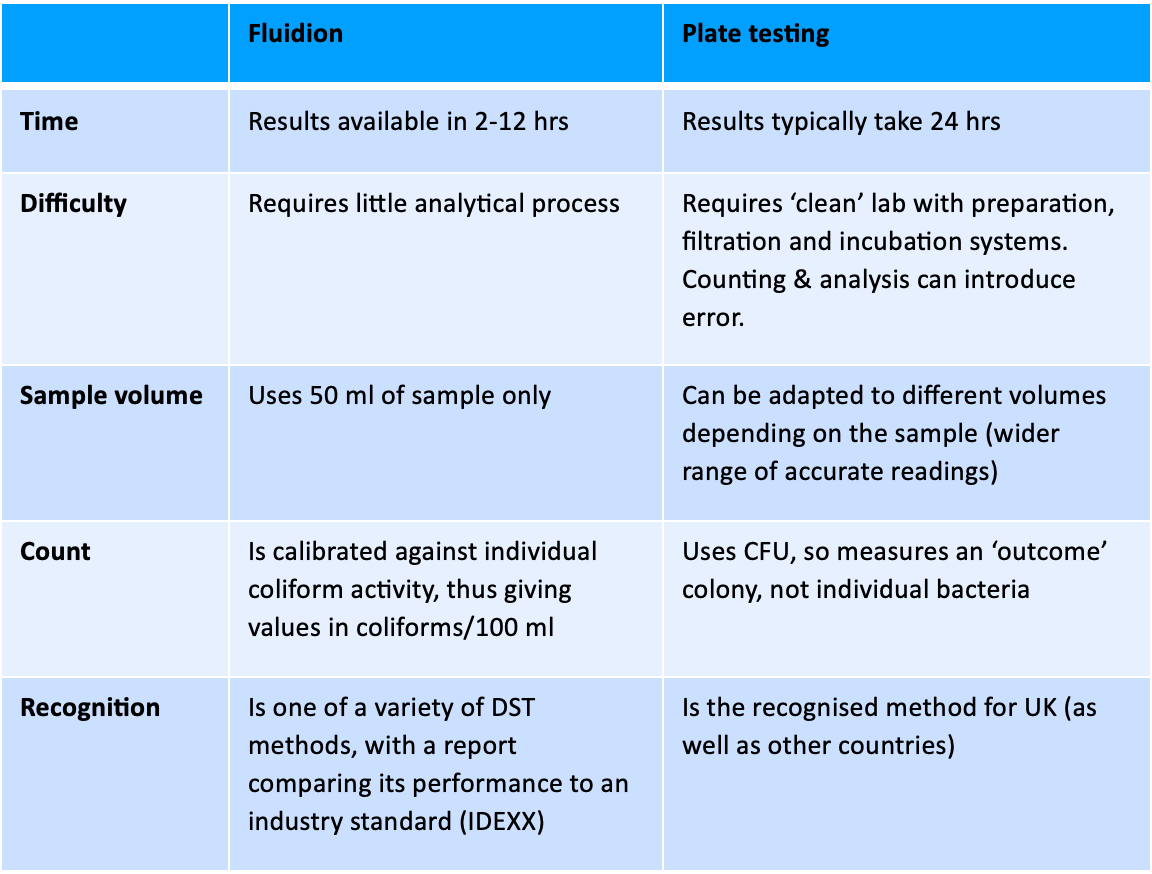
The lab process gives a result in Colony Forming Units (CFUs) as it involves counting the blobs on the filter and a blob could arise from a single bacterium, or from a cluster of bacteria which were present before incubation. The resultant colony of bacteria is what is counted. Fluidion technology counts the number of individual bacteria that exist by the end of the controlled incubation period and calculates back to the number of bacteria that must have been in the original sample. ERA was interested to know if this difference in the system would result in notably different readings from samples from the same container of river water.
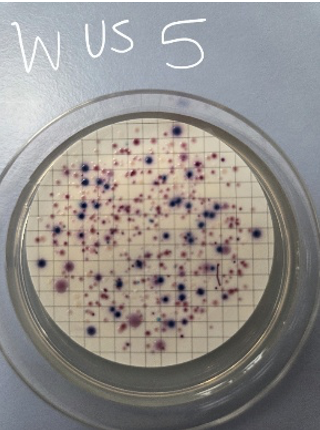
Colony Forming Units (CFUs) on a filter
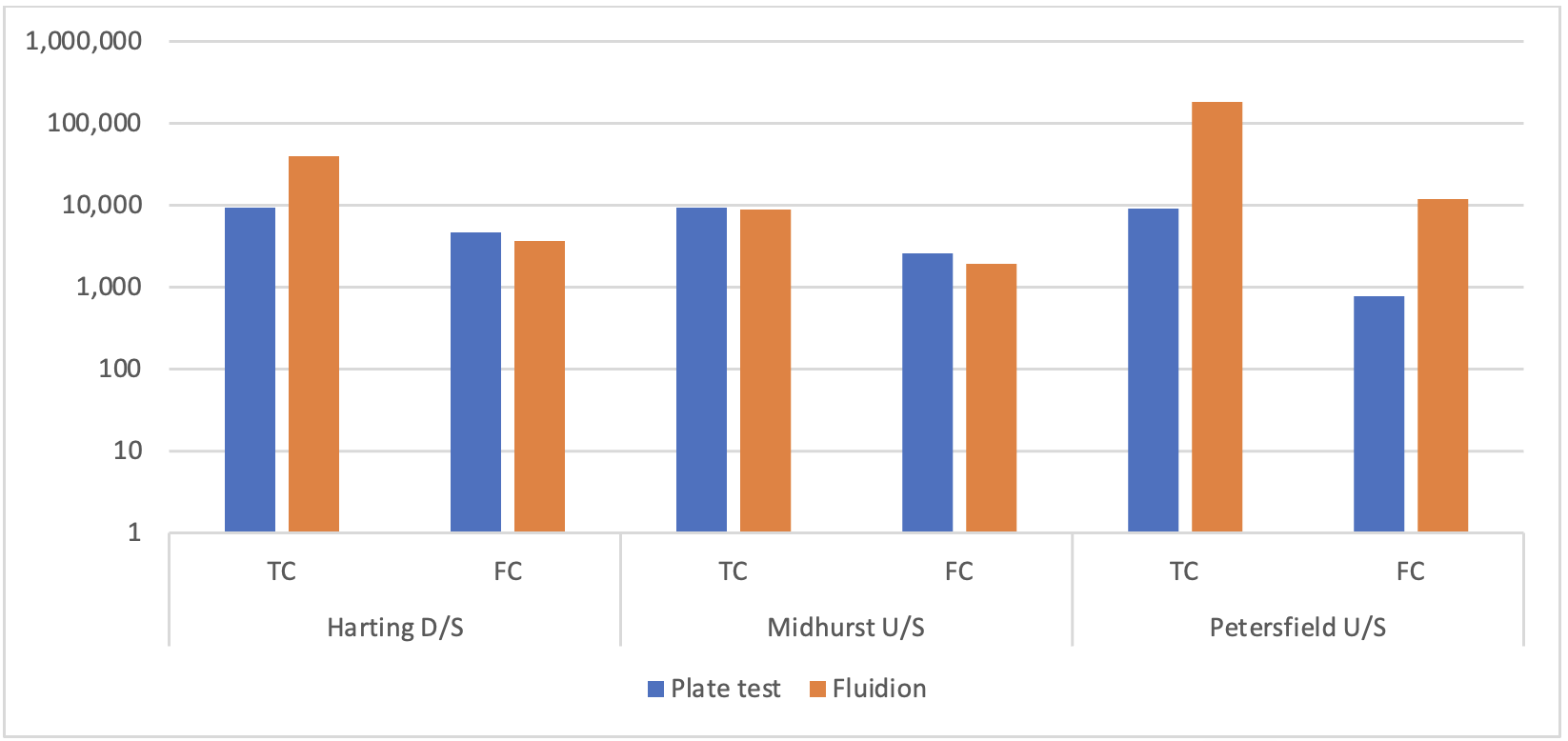
The data collected has not been fully analysed as yet, but Peter did have some results to share. In the following bar chart the brown bars are ERA’s Fluidion results and the blue bars are the student’s lab results. For the purposes of deciding if the results gave a reading in excessive of the Bathing Water Directive guideline figure, Peter was satisfied with the correlation between the two sets of results.
ERA’s methods of collections and set up were deemed reliable and our results are compatible. Our data is freely available on our website, but how do we ensure that it is found by those parties to whom it might be of use? We routinely report excessive results to the Environment Agency and to Southern Water.
Pleasingly, Peter went on to talk about potential future collaborations between ERA and his department. One possibility could involve eDNA testing which would indicate if the E.coli in a sample came from a human or animal source.
Beyond coliforms – emerging contaminants
Peter reminded us about emerging pollutants that he had mentioned earlier, providing an extensive list of potentially problematic examples including: pharmaceuticals and personal care products; Persistent Organic Pollutants (POPS); pathogenic bacteria; antibiotic resistant genes (ARGs); microplastics; nanoplastics; and many more. Regulation, monitoring and removal all need consideration.
A key issue around regulating water pollutants is being able to monitor them, and remove them, in a practical and economic manner. If monitoring is too difficult or expensive, then you cannot check or enforce any regulation. If there are not technically feasible methods to remove the pollutants, then regulating will not have the desired effect. On the other hand, the research to develop methods for monitoring and removal would be incentivised by knowing the regulation was forthcoming.
Treatment of emerging contaminants often involves physical methods, which work in at small scale; whereas biological treatment, which has traditionally been used in wastewater treatment, is more resilient at larger scale.
What can we all do to help?
ERA talks often finish with giving some consideration as to what our individual and collective roles might be, now that we have a better understanding of the issues. Peter’s talk did exactly that.
We can all play a role in reducing some of the above problems at source. I am sure ERA members all know the ‘3 Ps’, pee poo paper, as being the things that should go down the toilet. Other items such as wet wipes or sanitary items should not. We can also all attempt to hold back rainwater near where it falls, so that it does not literally flood the system at the wastewater treatment works. The bugs in the clinker beds work best with less dilute solutions, and once the storm tanks are full the excess will be directed straight into the waterway untreated (other than a moderate amount of settlement in the storm tanks). We can achieve this by creating rain gardens and other SUDS; by emptying, even partially, your rain butts before a storm; by installing slow-release rain butts.
I know this following suggestion does not appeal to everyone, but maybe the toilet does not need flushing after every small pee? ‘If it’s yellow let it mellow, if it’s brown flush it down!’
As ever, we have a role to play by emailing our MPs, or councillors, and then spread the word that you have done that as others may follow your lead. Look how quickly plastic straws and microbeads in cleansing products were dealt with once public opinion mounted against them.
Is there more that we could learn from other countries, such as Singapore, about using non-potable water where drinking water quality is not needed? Could we make greater use of grey water systems, for example, for flushing toilets?
Peters talk was jam-packed with facts and ideas, leaving us with plenty to think about. We hope that this link with his department will continue to develop. Both our E.coli Team and the rest of our membership hope to continue to benefit from this valuable link.