
Just what IS going on at Harting WTW?
The main problem at Harting Wastewater Treatment Works (WTW and aka sewage works) is that all too often Harting is discharging untreated effluent, ‘spilling’ to use the Southern Water terminology. (That is, untreated except for coming through filters down to 6mm square filters, plus some amount of settlement that might occurs while this effluent is in the storm tank.) That then goes into the very small Elstead Stream (called Harting Brook as it flows through the village itself). This is not illegal during times of exceptional weather, but should not be happening at other times. Harting is not the only site in the Rother valley that spills a lot, but it certainly has a poor history.
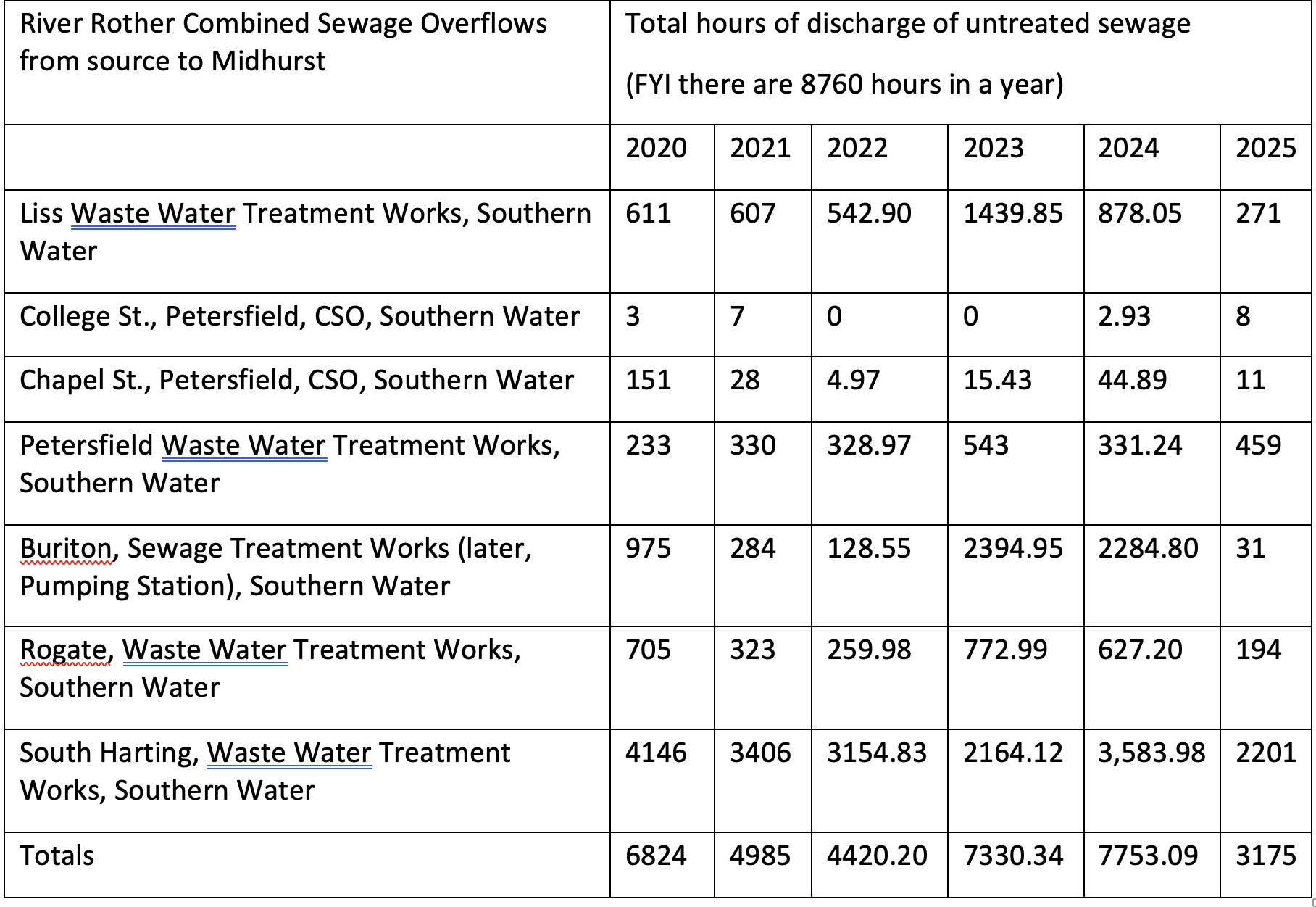
We simply do NOT have that many hours of ‘exceptional weather’ in any given year! (The 2025 figures reflect the fact that it was a very dry year, making it difficult to judge how much real progress has been made in reducing spills.)
Last year members of ERA’s E.coli Project team, together with members of Harting Parish Council, were given a tour of Harting WTW to see and discuss the considerable upgrade it had just had, plus ERA met again with Southern Water at the end of January 2026 to discuss various matters, including the fact that Harting was still spilling massively, ever after the upgrade. That upgrade had doubled the sites ‘flow to full treatment’, meaning it had doubled its capacity to process what arrives at it.
Spills are measured in hours with no attempt to measure volume. One cannot help but wonder just what volume of sewage must have been going into that tiny stream before the upgrade???
We are told by Southern Water that the problem is groundwater ingress into the foul sewage pipes that bring the effluent from the village to the site. Given that they do not measure the volume being released during spilling, they had no way of knowing if the upgrade would suffice to overcome that problem, other than to wait and see what happened during the following winter, this last winter. They did have Plan B ready if, as happened, the spilling was still at a totally unacceptable level. Plan B is to reline those pipes, an approach we are told they have used with good effect elsewhere. They also told us they would have done that before the upgrade if Defra (part of the Environment Agency) had approved the use of funds to do that, but Defra had wanted the upgrade done first. We have been told we can have another site visit to see and discuss the results of the pipe lining in due course.
If Plan B does not sort the problem they do have a Plan C, which is to purchase some adjoining land and create a managed reed bed to spill into. By the time that discharge has percolated down to the stream, nature will have partially processed it. I am sure that after the pipe relining we will have to wait and live through another winter before we will know if spilling is down to an acceptable level. I believe the long-term target is for spilling on 10 or less days per year, which would indeed be a huge improvement, if and when it is achieved.
Harting Parish Council also reports that ‘the inflow pipe continues to block, and spews out waste before reaching the works’. ERA knows no more about that issue or how it can be rectified.
Since our meeting with Southern Water in January we have been attempting to get an answer to the question of why the spills data for Harting keeps being retrospectively changed every few weeks. Legally, information about all spills has to be put into the public domain by all water companies in what they term ‘near real time’, which is taken to mean within an hour of it happening. For Southern Water this reporting happens via the Rivers and Seas Watch (R&SW) website. The data for Harting often contradicts itself and then gets revised/changed every 4 to 6 weeks, meaning that before those corrections the data on the site must have been wrong.
Finally on 31 April we received a meaningful response. We had submitted an EIR request (like a freedom of information request but for environmental matters). When we were unsatisfied with their response to that we requested an Internal Review, which we also felt had its limitations! On 14 April we mentioned to Southern Water that we were considering taking this matter to The Information commissioner. The most important information in this latest response is that we were told that on 23 April a particular piece of kit had been recalibrated which should greatly improve the situation. In fact, there was a lot of useful information in this recent response but it still leaves us with questions. However, we have been invited to join their Rivers & Seas Watch user engagement group. Could prove interesting, and might be a swifter route to getting questions answered.
In the meantime, we will continue to monitor the situation.
However, as I write this there remains data on Rivers and Seas Watch which makes no sense:
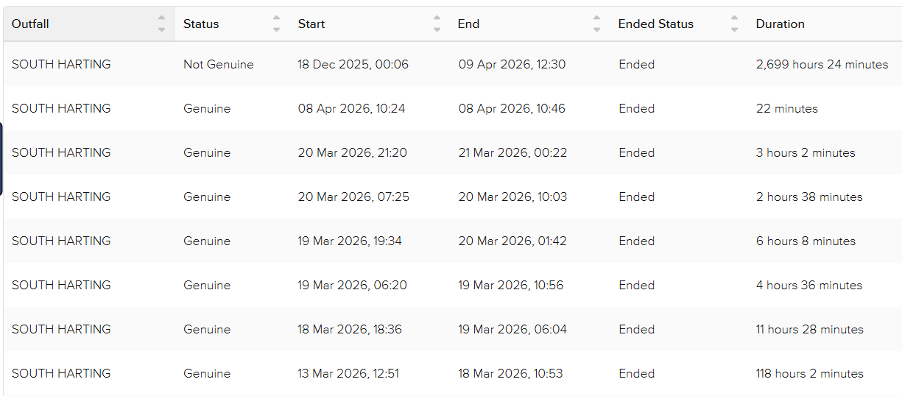
Screenshot taken 010526, 16:50
It is only the top entry that makes no sense. The other entries show several discreet spills in March and April, all of which have ended, implying no current spilling. The top entry says there has been a continuous spill since December. They cannot both be true, spilling is a binary thing, it is happening or it is not. It does state that it is ‘Not Genuine’ but even so, it seems unprofessional for that line to be left on there, week after week. It has been there since at least 14 April when we first noted it.
Excessive spilling is a much more important issue, but that does not mean we should turn a blind eye to issues around spills reporting on Rivers and Seas Watch.
For information about our E.coli monitoring project, including all our results to date, see https://ecorotheraction.org/fluidion-alert-one